AuRAT
1. Executive Summary
This report details the comprehensive technical analysis of the Aurat malware sample, a reverse engineering challenge provided by MalOps.io (https://malops.io/challenges/aurat). The sample is a sophisticated, custom-built Backdoor developed in C++ designed to simulate a realistic targeted attack.
Key Findings:
- Defense Evasion: The binary employs advanced evasion techniques, including header tampering (removal of DOS/PE signatures) to defeat static scanners and Dynamic API Resolution (using a DJB2 hashing algorithm) to conceal its import table and functionality.
- Network Resilience: The malware operates a robust Command and Control (C2) infrastructure with a failover mechanism. It iterates through three hardcoded C2 servers, attempting to tunnel traffic first via DNS (Port 53) and falling back to HTTPS (Port 443).
- Encrypted Communication: Network traffic is protected using AES-128 encryption via the Windows CryptoAPI, rendering network-based signature detection ineffective without the encryption keys.
- Malicious Capabilities: The malware possesses a versatile command set allowing it to:
- Self-Verification: Before any C2 communication, the malware verifies it is running inside svchost.exe under the SYSTEM account. If not, it exits immediately — confirming this DLL is designed to be injected by an external loader.
- Execute Shellcode: Receives shellcode from C2, stages it in memory via VirtualProtect (PAGE_EXECUTE_READWRITE), and executes it in-process across a chained opcode sequence (5 → 6 → 7).
- Token Impersonation: Steals active user session tokens via WTSQueryUserToken and spawns processes under the stolen identity using CreateProcessAsUserA.
- Download & Execute: Drops files to disk and loads plugin modules directly into memory.
- Reconnaissance: Harvests usernames, OS versions, computer names, local IP, and active session data.
2. Technical Analysis
2.1. Sample Overview
The sample is a binary file with a size of 117756 bytes and the following SHA-256 identifier: 9d4600b440a7c730737f83de7188cc68e83124a10934c3d280610b8709084859
1 | dir challenge |
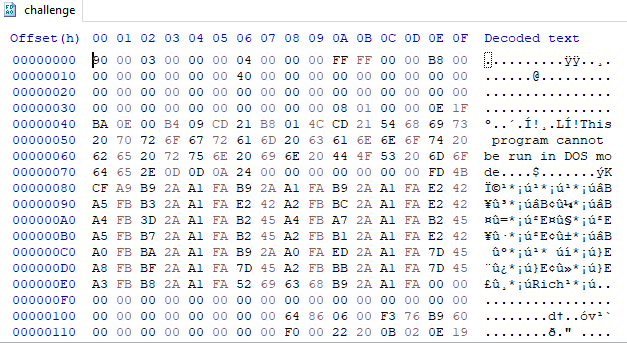
Initial inspection of the sample reveals the absence of the standard MZ DOS header and PE signature required for a valid Windows Portable Executable. This indicates deliberate header tampering, a commonly used technique to evade static analysis.
2.2. Header Reconstruction
2.2.1 DOS Header Reconstruction
The first 64 bytes of a Windows Portable Executable correspond to the DOS header (IMAGE_DOS_HEADER). This header begins with the magic value MZ (0x4D5A), which identifies the file as a DOS/Windows executable and enables the Windows loader to parse subsequent PE structures.
1 | typedef struct _IMAGE_DOS_HEADER { // DOS .EXE header |
In the sample, the DOS header data is present but the MZ magic bytes are missing due to intentional header tampering.
To restore the DOS header, two bytes were inserted at the beginning of the file using a hex editor (Edit → Insert Bytes) and modified to the correct magic value: 4D 5A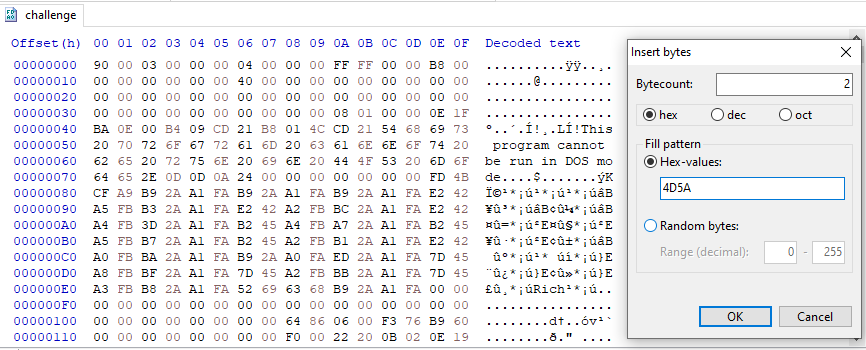
After inserting the MZ signature, the DOS header is structurally valid.
e_lfanew Field Analysis
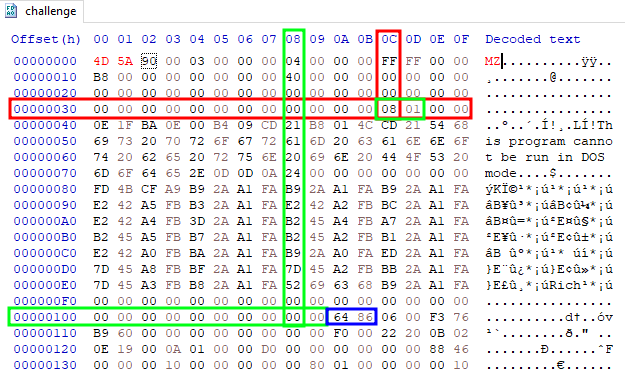
One of the most critical fields within the DOS header is e_lfanew, a 4-byte value located at offset 0x3C. This field specifies the file offset to the NT Headers (IMAGE_NT_HEADERS), which contain the PE signature, File Header, and Optional Header.
In this sample, the e_lfanew value points to offset 0x180, indicating the location of the NT Headers within the file. This confirms that the remainder of the PE structure exists and that only the initial header values were modified.
2.2.2 NT Headers and PE Signature
At the offset specified by e_lfanew, a valid PE file must contain the PE signature, which consists of the 4-byte magic value:
1 | 50 45 00 00 ("PE\0\0") |
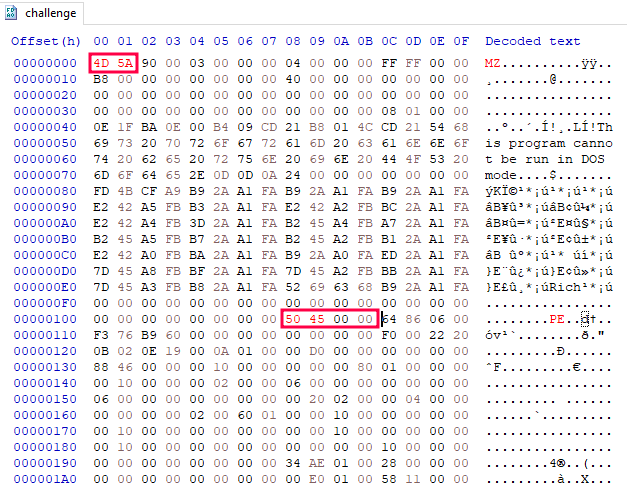
Analysis of the sample shows that while the NT Headers region is present, the PE signature is missing, further confirming intentional header manipulation.
Immediately following the PE signature is the IMAGE_FILE_HEADER, which has a fixed size of 20 bytes and is defined as:
1 | typedef struct _IMAGE_FILE_HEADER { |
For a deeper understanding of the Windows PE file structure, I recommend checking out this article.
Creds: @m7mad
Architecture Identification
The Machine field within the IMAGE_FILE_HEADER identifies the target architecture of the executable. Common values include:
1 | 0x014c = Intel 386 (x86) |
In this sample, the Machine value is 0x8664, indicating that the malware is compiled as a 64-bit (x64) Windows executable.
By inserting the PE magic bytes (0x50 0x45), the executable structure is restored with both a valid DOS header and PE signature.
2.3. File Identification
After reconstructing the PE headers, the sample is correctly parsed as a 64-bit Windows Portable Executable (AMD64). The binary is marked as a DLL, however, no exported functions are present, suggesting it is not intended to be loaded through standard DLL export mechanisms.
| Property | Value |
|---|---|
| File Name | challenge |
| File Type | PE64 DLL (Windows GUI) |
| Architecture | AMD64 (x86-64) |
| File Size | 115.00 KiB (0x1CC00 bytes) |
| MD5 | d8b5d297fd6218966461df97fabf630a |
| SHA-1 | 7a2751f54c81b48064d7f7ccc92e49e6433ad872 |
| SHA-256 | 59742e7579553262987fa0789f8df05e9575c645a32eeb9986f47e87be4312cf |
| Compilation Timestamp | 2021-06-03 17:42:27 |
| Entry Point | 0x180004688 |
| Compiler / Language | Microsoft Visual C/C++ |
| Toolchain | Visual Studio 2017 / 2019 |
| Linker Version | 14.25 |
| Operating System | Windows (AMD64, 64-bit) |
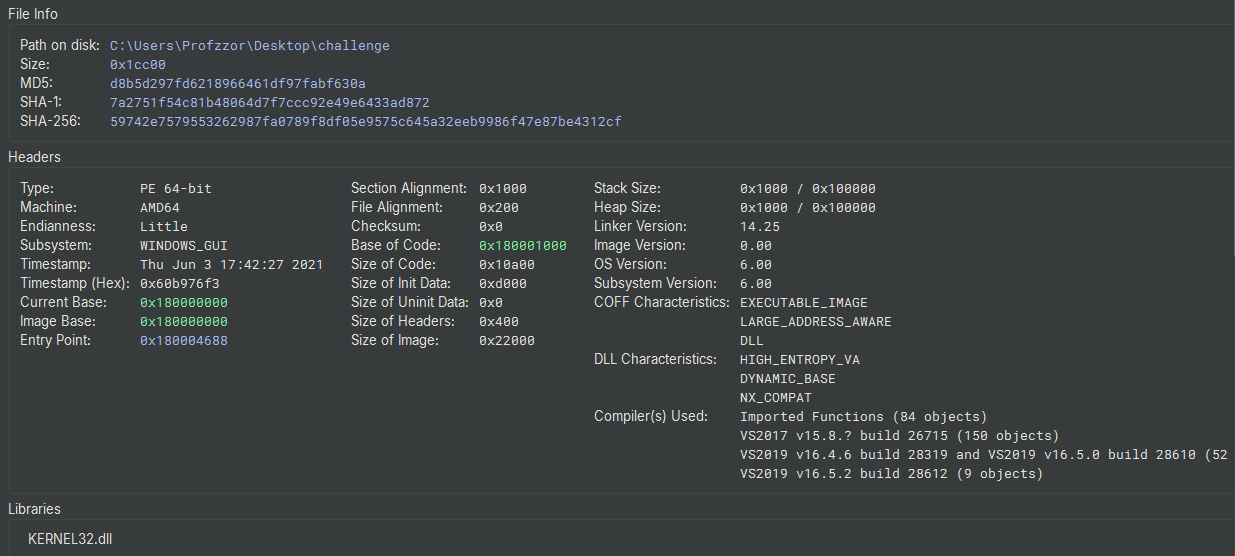
The import table lists only KERNEL32.dll, indicating that the malware likely resolves additional APIs dynamically at runtime rather than through static imports, a common technique used to reduce static visibility and hinder analysis.
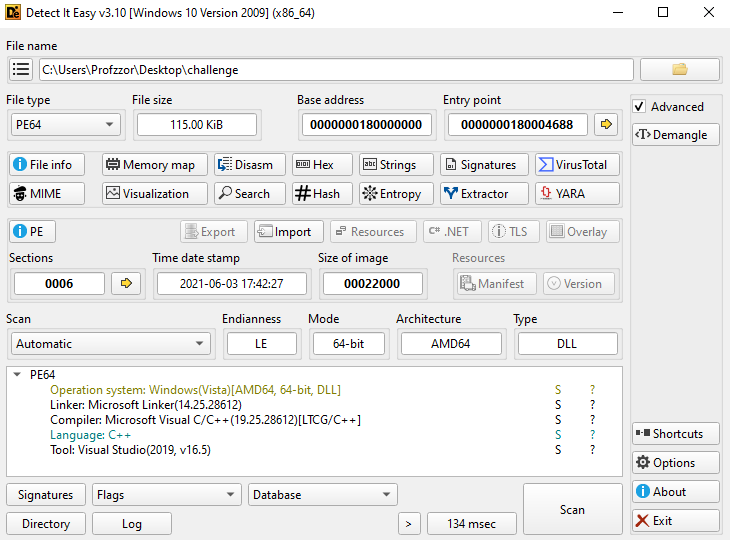
2.4. Static Analysis
2.4.1. Entry Point Analysis
The analysis begins at the entry point address 0x180004688 (_start). Examination of the decompiled code reveals that this section consists of standard initialization routines generated by the Microsoft Visual C/C++ compiler, rather than custom malicious logic.
The entry point performs the following operations:
Stack Cookie Initialization:
The function calls_security_init_cookie(at 0x1800046d0). This is a standard Microsoft CRT (C Runtime) routine used to initialize the Global Security Cookie (GS Cookie) for stack buffer overflow protection.As seen in the decompiled code, it gathers entropy using:
- GetSystemTimeAsFileTime
- GetCurrentThreadId
- GetCurrentProcessId
- QueryPerformanceCounter
This confirms the code is compiler boilerplate intended to harden the binary against exploitation.
CRT Dispatcher:
The code subsequently calls dllmain_dispatch (0x180004554), which acts as the wrapper for the standard_DllMainCRTStartup. This function is responsible for initializing the C/C++ runtime environment (constructors, static variables) before passing execution to the developer-written main function.Inside dllmain_dispatch, the code handles standard DLL states (DLL_PROCESS_ATTACH, DLL_THREAD_ATTACH, etc.) and eventually directs execution to sub_180003fc0:
1 | // Extract from dllmain_dispatch |
2.4.2. Analysis of User Code (DllMain)
The function sub_180003fc0 serves as the actual entry point for the user-defined code (the real DllMain).
Upon execution, it checks if arg2 (the fdwReason) equals 1 (DLL_PROCESS_ATTACH). If the DLL is being loaded into a process, it performs two distinct function calls using a helper function sub_180001000. This helper function takes a hexadecimal integer as an argument, which suggests it is an API hashing routine used to resolve function pointers dynamically.
1 | // Decompiled Logic of sub_180003fc0 |
To understand what these functions do, we must analyze the hashing algorithm implemented in sub_180001000.
2.4.3. Dynamic API Resolution (API Hashing)
The malware employs a technique known as Dynamic API Resolution to conceal its imported functions from static analysis tools. This is handled by sub_180001000 and sub_180004030.
Module Base Resolution
The function sub_180004030 is responsible for locating the base address of a specific system DLL without using GetModuleHandle. It accesses the Process Environment Block (PEB) via the GS register (on x64 systems, GS:[0x60] points to the PEB).
It traverses the PEB_LDR_DATA structure:
- Accesses InLoadOrderModuleList.
- Traverses the doubly linked list 3 times (Flink->Flink->Flink).
Thus, the function returns the base address of kernel32.dll.
Hashing Algorithm
Once the base address of kernel32.dll is obtained, sub_180001000 parses its Export Table. It iterates through the export names and calculates a hash for each name using a specific algorithm found in the inner loop:
1 | rax_1 = rax_1 * 0x21 + sx.d(i) |
This is a variant of the DJB2 hashing algorithm, using the multiplier 0x21 (33 decimal). The logic is:
1 | hash = hash × 33 + char |
Hash Decryption
Automated resolution of API hashes is typically performed using community-driven plugins such as HashDB (available for IDA Pro, Ghidra, and Binary Ninja Commercial). These tools query a central database to identify hashing algorithms and resolve values dynamically.
However, this analysis is being conducted using Binary Ninja Free, which does not support the internal Python API or third-party plugins. To overcome this limitation and resolve the 121 API calls identified in the binary, an external static analysis approach was adopted.
A standalone Python script was developed to generate a “Rainbow Table” (a pre-computed reference list). The script mimics the malware’s specific DJB2 hashing logic (hash * 33 + char) and iterates through the Export Address Tables (EAT) of common Windows system DLLs. This produces a searchable text file mapping the malware’s hashes to their corresponding human-readable API names.
Python Resolution Script (resolver.py):
1 | import pefile |
The script requires the pefile library to parse the DLL headers. The output is redirected to a text file for easy searching during manual analysis.
1 | python -m pip install pefile |
Reconstructed DllMain Logic
With the hashes resolved, the behavior of sub_180003fc0 becomes clear:
- Anti-Analysis / Logging:
It callsOutputDebugStringA("DLL_PROCESS_ATTACH"). Signal that execution has begun. - Payload Execution:
It callsCreateThreadto execute the main malicious code located at sub_180003f60.
1 | CreateThread(NULL, 0, (LPTHREAD_START_ROUTINE)sub_180003f60, &data_18001c9f0, 0, 0); |
3. DllMain
3.1. Thread Entry Point (sub_180003f60)
The new thread spawned by DllMain executes the function sub_180003f60. This function acts as the initialization routine for the malware’s core logic.
Using our generated API reference list (Rainbow Table), we resolved the first API call in this function:
- Hash 0xb9f2133d -> GetProcessHeap (Kernel32.dll)
3.1.1. Object Allocation
After resolving GetProcessHeap, the function calls a memory allocation routine. Although the decompiler labels it _get_terminate, the arguments match the signature of HeapAlloc:
1 | // 0xb9f2133d -> GetProcessHeap |
- Handle: Result of GetProcessHeap().
- Flags: 8 (Corresponds to HEAP_ZERO_MEMORY).
- Size: 0x98 (Decimal 152 bytes).
This confirms the malware is allocating a 152-byte structure on the heap. This structure likely holds the malware’s runtime configuration or “Context.”
3.1.2. Initialization and Execution
Once the memory is allocated, the pointer to this structure (rax_3) is passed through two key functions:
Constructor (sub_180002110):
1 | rax_3 = sub_180002110(rax_3) |
This function takes the empty 152-byte buffer and populates it. In C++ malware, this is typically the Class Constructor, responsible for setting default values.
Main Routine (sub_180002460):
1 | sub_180002460(rax_3, arg1, arg3, arg2) |
The initialized structure and the global data pointer (arg1 / data_18001c9f0) are passed to this function. This is likely the “Run” method of the malware.
3.2. Modular API Resolution
The malware uses dedicated loader functions for specific system libraries. This structure confirms the malware’s modular design.
| Resolver Function | Targeted DLL | Purpose |
|---|---|---|
| sub_180001000 | Kernel32.dll | Core system APIs (process, memory, threads, loader) |
| sub_180001160 | User32.dll | Windowing, input handling, UI interaction |
| sub_1800012d0 | Msvcrt.dll | C Runtime (strings, memory, formatted I/O) |
| sub_180001430 | Advapi32.dll | Registry, services, security, user management |
| sub_180001590 | Wtsapi32.dll | Terminal Services / session enumeration |
| sub_1800016f0 | Shell32.dll | Shell operations, filesystem helpers |
| sub_180001850 | Ws2_32.dll | Networking (sockets, DNS, TCP/IP) |
| sub_1800019b0 | Userenv.dll | User profiles, environment variables |
3.3. Payload Initialization (Constructor Analysis)
The function sub_180002110 takes the previously allocated 152-byte structure (passed as arg1) and populates it with runtime configuration and victim data. This process relies heavily on the modular API resolvers identified in Section 3.2.
3.3.1. Network Initialization
The very first action is to initialize the Windows Sockets library.
1 | // Hash 0x2b7ae73e -> WSAStartup |
The malware requests Winsock version 2.2 (0x202), confirming that it intends to communicate over the network.
3.3.2. Target Path Generation
The malware constructs a specific file path, likely for a secondary payload or self-replication.
- Get System Directory:
It allocates a buffer (0x104 bytes) and calls GetWindowsDirectoryA.
1 | // Hash 0xefeef041 -> GetWindowsDirectoryA |
- Append Filename:
It appends the string \Temp\auk.exe to the directory path using lstrcatA.
1 | // Hash 0x570c615e -> lstrcatA |
Result: The malware targets the path C:\Windows\Temp\auk.exe.
3.3.3. System Reconnaissance (Victim Profiling)
The function proceeds to gather unique identifiers from the infected machine. These are stored in a larger internal structure allocated during execution (size 0x278).
- OS Version:
It calls GetNativeSystemInfo (Hash 0x5cbebb8) and checks specific version numbers (likely checking for Windows 10/Server 2016/2019 versions corresponding to major version 9 or 6). It sets a configuration flag at offset 0x92 based on this check. - Username:
It uses the Advapi32 resolver to steal the current user’s name.
1 | // Hash 0x4320e6c1 -> GetUserNameA |
- Computer Name:
It uses the Kernel32 resolver to get the machine name.
1 | // Hash 0xec9840b1 -> GetComputerNameA |
3.3.4. Local IP Discovery
The malware attempts to identify the local IP address of the victim machine using standard Winsock APIs:
- gethostname (0x78cc8e3f): Retrieves the local computer name.
- gethostbyname (0xc3de085a): Resolves the host name to a host entry structure.
- inet_ntoa (0x57116105): Converts the retrieved raw IP address into a human-readable string (e.g., “192.168.1.50”).
3.3.5. Bot Versioning
Finally, the malware stamps the configuration structure with a version string.
1 | __builtin_strncpy(&var_318, "V1.1", 4); |
At the end of sub_180002110, the malware has prepared a configuration object containing:
- Target Path:
C:\Windows\Temp\auk.exe - Username:
[Current User] - Computer Name:
[Host Name] - Local IP:
[IP Address] - Bot Version: V1.1
3.4. Command and Control (C2) Loop
The function sub_180002460 implements the primary lifecycle of the malware. It performs an initial uniqueness check and then enters an infinite loop to manage C2 communications.
3.4.1. Persistence and Mutex Check
At the very beginning of the loop, the malware attempts to ensure only one instance is running.
1 | // Hash 0x16fe6d88 -> CreateMutexA |
It creates a mutex named “V4.0”. If GetLastError returns 0xB7 (ERROR_ALREADY_EXISTS), the malware terminates, preventing multiple infections on the same host.
3.4.2. Main Execution Loop
If the mutex is successfully acquired, the malware enters an infinite while(true) loop (Address 0x180002506). This loop orchestrates the connection attempts and command processing.
Session Cleanup:
The first action within every iteration of this loop is a call to sub_180001e70.
1 | while (true) |
This function resets the internal state by iterating through active task objects and releasing their memory using HeapFree. This ensures that if a connection fails or a command finishes, the next attempt starts with a clean slate.
3.4.3. Connection Establishment (Redundancy Logic)
The function sub_180003720 is responsible for establishing the network connection to the Command & Control server. It employs standard Windows Sockets (Winsock) but implements a failover strategy to ensure connectivity even if the primary server is down.
Socket Creation
The function begins by creating a standard TCP/IPv4 socket:
1 | // Hash 0x1451fe69 -> socket |
Failover Configuration
The malware accesses a configuration structure pointed to by (arg1 + 0x28). It attempts to connect to up to three different C2 servers sequentially. If one attempt fails, it closes the socket (closesocket), creates a new one, and tries the next configuration slot.
1. Primary C2 Attempt:
- Address Offset: 0x30 -> 10.21.72.11
- Port Offset: 0x24 -> 0x0035 -> 53
1 | // Attempt 1: Connect to 10.21.72.11:53 |
2. Secondary C2 Attempt (If Primary Fails):
- Address Offset: 0x58 -> 5.34.176.199
- Port Offset: 0x26 -> 0x01BB -> 443
1 | ResolveWS2_32_API(0x5de2e91f)(socket); // closesocket |
3. Tertiary C2 Attempt (If Secondary Fails):
- Address Offset: 0x80 -> 45.134.17.171
- Port Offset: 0x06 -> 0x01BB -> 443
- Logging: Before this attempt, it formats the string %s:%d (using wsprintfA from User32) and logs it via OutputDebugStringA, indicating a last-resort attempt.
Helper Functions
- sub_1800035f0 (DNS Resolution):
- Hash 0xc3de085a -> gethostbyname: Resolves a hostname to an IP.
- Hash 0xbf9998e1 -> inet_addr (or similar IP copy): Copies the IP address.
- It logs “Gethos failed” if resolution fails.
- sub_180003490 (Socket Connect):
- Hash 0x79b772c -> htons: Converts port number to network byte order.
- Hash 0xbf92328a -> inet_addr: Converts string IP to integer.
- Hash 0xcfb6b06a -> connect: Attempts the TCP connection.
- It logs “Tcp failed” or “Tcp succeed” using OutputDebugStringA.
3.5. C2 Communication Protocol
Once the network socket is established, the malware enforces a strict encrypted communication protocol. This ensures the integrity and confidentiality of the command stream.
3.5.1. Encryption Mechanism
Traffic is encrypted using the Windows CryptoAPI (advapi32.dll). The function sub_180001b10 handles the cryptographic operations:
- Algorithm: The malware imports a hardcoded key using CryptImportKey with parameters (0x660e), identifying the algorithm as AES-128.
- Hashing: Before encryption, the payload is hashed (CryptCreateHash / CryptHashData) to generate a signature, likely for integrity verification.
- Operation: The data is encrypted using CryptEncrypt before being sent and decrypted using CryptDecrypt upon receipt.
ALG_ID (Wincrypt.h) - Win32 apps | Microsoft Learn
3.5.2. Handshake and Initial Packets
The main loop (sub_180002574) reveals the initial handshake sequence performed immediately after a successful connection.
1. Initial Beacon (sub_180003290)
The function sub_180003290 is called first. It packages the victim profile (User, OS, IP) created in the Constructor, encrypts it, and transmits it to the C2.
2. Status Update Packets (Types 8 and 5)
If the beacon is sent successfully (rax_12 != 0), the malware performs two status checks and sends specific packet types using the packet builder function sub_180001cf0.
- Packet Type 8 (Initial Status):
Checks the flag at offset 0x31. If 0, it sends a packet with ID 8.
1 | // sub_180001cf0(Command_ID, Data, Size, Output) |
- Packet Type 5 (Extended Info):
Checks the pointer at offset 0x20. If NULL, it sends a packet with ID 5.
1 | sub_180001cf0(5, (char*)arg1 + 0x91, 1, &var_bc); |
3.5.3. Packet Construction (sub_180001cf0)
The helper function sub_180001cf0 acts as the generic “Packet Builder”. It performs the following steps:
- Allocation: Allocates memory for the packet buffer.
- Header Generation: Writes the Command ID (e.g., 8, 5, or 13) into the header.
- Encryption: Calls sub_180001b10 to encrypt the payload and header.
- Finalization: Returns the pointer to the encrypted blob, ready for transmission via sub_180001fb0 (Send).
3.6. Command Dispatcher
The core functionality of the malware lies in its ability to receive and execute commands from the C2 server. The loop in sub_180002460 parses incoming packets and dispatches them based on a Command ID (rax_35 in the decompiled code).
3.6.1. Command Table
| Command ID | Action | Technical Description |
|---|---|---|
| 0x03 | Sleep / Terminate | Multiplies received value by 0xea60 (60,000ms). If non-zero, closes socket and sleeps. If zero, sets exit flag and terminates. |
| 0x04 | Execute Shellcode | Sets execution flag at offset 0x90, calls VirtualProtect(RWX) on the payload buffer, then executes it directly in the current process. |
| 0x05 | Payload Staging | Calls sub_180003ae0 to copy the received payload into the context buffer and reads svchost.exe from disk for PE layout reference. No execution occurs at this stage. |
| 0x06 | Shellcode Execution | Verifies staged payload exists, calls VirtualProtect(RWX), then executes the buffer directly inside the malware’s own process. |
| 0x07 | Shellcode Execution + Flag | Identical to 0x06 but additionally sets an internal state flag signaling execution completion. |
| 0x08 | Load Plugin Module | Allocates a memory slot, copies received data via memcpy, sets VirtualProtect(RWX), executes the module entry point, and registers it in the plugin slot array. |
| 0x09 | Reset / Cleanup | Calls sub_180001e70 to free all allocated plugin objects, resets the plugin counter and slot arrays. |
| 0x0A | Send Heartbeat | Builds and sends a status packet (type 8) containing the OS version flag back to the C2. |
| 0x0B | Token Impersonation + Process Spawn | Major Capability. Enumerates active sessions (WTSEnumerateSessionsA), steals the active user token (WTSQueryUserToken), drops a file to disk (CreateFileA + WriteFile), then spawns a process under the stolen token identity (CreateProcessAsUserA). |
| 0x0C | Spawn Process | Calls ShellExecute/CreateProcess to run a command or file. Checks exit code via GetExitCodeProcess and reports result back to C2 via packet type 0xB. |
| 0x0D | Drop File to Disk | Creates a file at the configured path (CreateFileA with GENERIC_WRITE), writes the received payload (WriteFile), then closes the handle. |
| 0x0E | Terminate | Clears the payload buffer pointer at offset 0x20 and sets the exit flag at offset 0x90, causing the main loop to exit. |
3.6.2. Shellcode Execution Chain (Opcodes 5, 6, 7)
The malware implements an in-process shellcode execution capability spread across three opcodes that must be triggered in sequence by the C2 operator.
Opcode 5 — Staging (sub_180003ae0)
When the C2 sends opcode 5, the malware calls sub_180003ae0, which performs the following:
- Copies the received payload from the C2 into an internal context buffer (
arg1+0x70) - Stores the payload size at
arg1+0x18and the buffer pointer atarg1+0x20 - Calls sub_180003d70 to read the legitimate svchost.exe binary from disk and bundles it with the context struct — the complete bundle is sent to the C2 as opcode 6. The exact purpose of sending the svchost.exe bytes to C2 is unclear from the implant code alone, as the C2 server logic is not available for analysis.
- Reports staging status back to the C2
No execution happens at this stage.
Opcode 6 — Execution
When the C2 sends opcode 6, the dispatcher:
- Checks that
arg1+0x18(size) andarg1+0x20(buffer) are populated — meaning opcode 5 must have run first - Calls
VirtualProtectwith flag0x40(PAGE_EXECUTE_READWRITE) on the buffer - Directly calls the buffer as a function — executing the shellcode inside the malware’s own process
Opcode 7 — Execution + State Flag
Identical to opcode 6 but additionally sets an internal state flag, likely signaling to other components that execution has completed.
4. Conclusion
The analysis of the Aurat challenge identifies the binary as a complex, modular backdoor written in C++. The design of this specimen exhibits a high degree of sophistication, characterized by the use of Object-Oriented programming patterns, custom dynamic API resolution for evasion, and a resilient, encrypted network communication protocol.
Technical Recap:
- Entry & Initialization: The malware initializes by repairing its own headers in memory and resolving necessary Windows APIs dynamically to hide its intent. It ensures a single instance runs using the Mutex V4.0.
- Victim Profiling: Before connecting, it aggregates victim data (Hostname, IP, OS, User) into a specialized configuration structure.
- C2 Protocol: It attempts connections to 10.21.72.11, 5.34.176.199, and 45.134.17.171. All traffic is hashed for integrity and encrypted with AES-128.
- Payload Execution: The command dispatcher supports 14 distinct commands. This DLL is itself the injected payload — it verifies at startup that it is running inside svchost.exe as SYSTEM, confirming injection was performed by an external loader before execution. Key capabilities include in-process shellcode execution (opcodes 5→6→7), token impersonation via WTSQueryUserToken + CreateProcessAsUserA, and a plugin loading system for extending functionality at runtime.